



Grand Coulee is the largest dam in the Columbia River Basin and one of the largest in the world. Everything about the dam is large: it is 550 feet (167.6 meters) tall, measured from its foundation in solid granite, or approximately 350 feet (106.7 meters) from the downstream river surface to the top of the dam. It is 5,223 feet (1,592 meters) long, or 57 feet short of a mile.
For a time, Grand Coulee Dam was the largest concrete structure ever built, but today that distinction goes to the Three Gorges Dam in China, completed in 2009. It is roughly three times the size of Grand Coulee. Grand Coulee is 450-500 feet thick at its base and 30 feet thick at the top, and it contains 11,975,521 cubic yards (9,155,944 cubic meters) of concrete, three times as much as Hoover Dam.
The dam has four power plants. The two original power plants, the first of which began producing power in 1941, are called the Left Power Plant and the Right Power Plant, following the standard naming protocol of facing downriver. The two power plants, each of which houses nine large generators, are split by the spillway, which is 1,300 feet wide and covers an area of 13.26 acres. According to the federal Bureau of Reclamation, which operates the dam, the Left Powerhouse has three generators with a total capacity of 3 megawatts to provide power at the dam site, plus nine generators rated at 125 megawatts each. The Right Powerhouse has nine generators rated at 125 megawatts apiece. The original 18 generators began operating between 1941 and 1950. The Third Power Plant contains three generators rated at 600 megawatts apiece and three rated at 805 megawatts. These first of these six generators began operating in 1975, and the sixth in 1980. The John W. Keys Pump-Generator Plant, which is located on the left bank of the river just upstream from the dam, contains 12 pumps that lift water up the hillside to a canal that flows into Banks Lake, the 27-mile-long reservoir for the Columbia Basin Project. Six of the pumps can be reversed to generate about 50 megawatts each with water flowing back down from Banks Lake.
Individual penstocks carry water to each generator at Grand Coulee. The largest of these, at the Third Power Plant, are 40 feet in diameter and carry up to 35,000 cubic feet per second of water, or more than twice the average annual flow of the Colorado River. The dam complex includes three switchyards to transmit electricity into the regional power grid.
The total generating capacity is 6,809 megawatts and its average annual energy output is about 2,300 megawatts, or enough power to continuously supply the needs of two cities the size of Seattle.
Grand Coulee is located at river mile 596.6 in central Washington (see Google Earth map) about 90 miles northwest of Spokane near the place where an ice floe dammed the river during the last Ice Age. The ice forced the river to rise from its historic channel and flow to the south, where it carved a giant canyon — the Grand Coulee. Eventually the ice retreated, and the river returned to its old channel
Grand Coulee impounds a reservoir, Franklin D. Roosevelt Lake, named for the president who authorized construction of the dam, which began in 1933 (see construction photos). Lake Roosevelt backs up the river almost to the Canadian border, a distance of 151 miles.
Hydropower accounts for 79.7 percent of Grand Coulee’s authorized purposes, the others being irrigation and flood control. While hydropower is the primary purpose of the dam today, the public desire for irrigation was the driving force behind its construction. One of the first, if not the first, published reports of a proposal to irrigate the Columbia Plateau with water from the Columbia River was in 1892, when the Coulee City News and The Spokesman-Review reported on a scheme by a man named Laughlin McLean to build a 1,000-foot-tall dam to divert the entire flow of the Columbia back into the Grand Coulee; he also earlier proposed a 95-mile canal across the Columbia Plateau from a diversion point somewhere farther upriver. These appear to be the first publicly discussed proposals for the dam that would be Grand Coulee, but they were just the ideas of a dreamer at the time.
The idea of a big dam at the Grand Coulee didn’t resonate with the public until 1918. That year Rufus Woods, the visionary publisher of the Wenatchee World newspaper, began advocating for a dam that would provide irrigation water to the Columbia Plateau. It was a crusade for Woods, a natural-born promoter, and from the beginning he had influential allies, including attorneys Billy Clapp and James O’Sullivan, both of nearby Ephrata. While no one person can be considered the “father” of the dam, these three men were among its earliest, most active and enthusiastic promoters. Clapp is credited with suggesting, in 1917, that if nature once blocked the Columbia with an ice dam that forced water into the now-dry Grand Coulee, man could do the same with concrete. O’Sullivan liked the idea and soon began writing articles about such a dam, and Woods published them in his newspaper.
There were two schools of thought at the time about how the Columbia Plateau might be irrigated: pumping water up from the river or diverting it from farther upstream and bringing it to the area in canals. Neither idea prevailed, but each had staunch advocates. The federal Reclamation Service and the state of Washington had spent thousands of dollars looking for ways to provide irrigation; a 1914 bond measure that would have paid for irrigating a portion of the area had failed.
O’Sullivan, Woods, Clapp and many other local people favored pumping water from behind a dam; influential business leaders in Spokane, home of the privately owned Washington Water Power Company, which owned its own hydroelectric dams, favored canals that would divert water from the Pend Oreille River in northeastern Washington. Soon, the battle was joined between the “pumpers” and the “ditchers.”
Pumpers like O’Sullivan saw potential benefits in hydropower. “The revenue from the sale of electric energy alone would surely pay all the upkeep, interest on the investment; and provide a sinking fund for the liquidation of the cost of the project itself,” he wrote in a 1918 article in the World.
The pumpers distrusted the ditchers, whose backers were the big business and power interests in Spokane, including Washington Water Power, Spokane’s biggest employer at the time. The ditchers wanted to irrigate the Columbia Basin with water from the Pend Oreille River. The canal would begin at Albeni Falls and run downhill, through tunnels where necessary, to the Ritzville area. The pumpers saw this as another attempt by arrogant Spokanites to control all of eastern Washington
Washington Governor Ernest Lister was a “ditcher.” In a speech in November 1918, he commented that “at least 50,000 families could be accommodated on the lands mentioned in the project.” Lister died in office in 1919, and the acting governor, Louis F. Hart, did not feel so strongly about the gravity project. This was a blow to the ditchers.
Washington Water Power tried to kill the pumping project by proposing to build its own dam at Kettle Falls. In 1922 the Federal Power Commission granted a preliminary permit. If the dam had been built, it would have limited the size of the dam at Grand Coulee 110 miles downriver, effectively killing the pumping proposal. The dam at Coulee had to be high enough to make pumping feasible. In response to Water Power’s ploy, Woods editorialized that the Spokane utility was a “soulless corporation.”
A variety of studies were conducted in the 1920s; some supported the canal plan and others the dam. Lobbying was fierce, as supporters of the two proposals sought to win members of Congress to their sides. There were public events — pro-canal or pro-dam rallies — and quieter behind-the-scenes lobbying. The Bureau of Reclamation, envisioning success with Hoover Dam, was partial to big irrigation projects. O’Sullivan personally lobbied Arthur Powell Davis, the Commissioner of Reclamation, to support the dam. Senators Wesley Jones and Clarence Dill of Washington persuaded President Hoover in 1929 to support a $600,000 study of Columbia River hydropower potential by the Corps of Engineers. The study by Major John S. Butler of the Seattle district of the Corps, completed in 1932, recommended a series of 10 dams on the river, including one at Grand Coulee and others in British Columbia. Called the “308 Report” for the number assigned to it by the House of Representatives, it supported a dam over a canal to provide irrigation water. The pumpers were pleased.
Roosevelt was elected president the same year the 308 Report was issued, and with the nation reeling from the Depression dams on the Columbia offered promise of employment as well as hydropower and irrigation. Roosevelt initially balked at the $450 million cost estimate for Grand Coulee (it was more than the Panama Canal, he argued, and would produce more power and potentially irrigate more than was needed at the time). But he had promised Dill before the election that he would build it if he won. Western support was critical to his victory, and now Dill — one of those supporters — pressed the president to follow through. Roosevelt responded that he would support a low dam — 150 feet tall from bedrock instead of 550 feet as proposed — that could be raised later, if necessary. Dill, shocked, countered with a proposal for $100 million; Roosevelt compromised at $63 million, and that was the deal. So construction began in 1933 on a low dam with a foundation large enough to eventually support a high dam. By 1935, the plans were upgraded and the high dam was under construction.
Roosevelt, a master politician, had found a way to mollify critics who said the dam would be too big and too expensive by beginning construction with a modest amount of money on a comparatively modest structure. The power generated by a high dam, eight times more than the low dam, would be used, he believed. Importantly, net revenues from power sales also would repay the cost of the project, and thus the $63 million was an allotment for a federal project, and it was understood the amount would be repaid. Roosevelt’s New Deal policies supported the concept of multiple purposes dams — dams that generate power and also provide water for irrigation, recreation and flood control. A low dam built solely for power did not fit the paradigm, but a multi-purpose high dam at Grand Coulee did.
Washington Governor Clarence Martin supported the high dam, and he reluctantly agreed that it should be a federal project, even though supporters like Woods and his Republican colleagues choked on the idea of a Democratic administration taking over “their” dam as a federal project. The Washington State Columbia Basin Commission, created for the purpose of directing state construction of the dam, whether a low dam or high dam, acquiesced to the federal takeover after finding itself hamstrung with state law requirements for such an undertaking and its own infighting. Woods objected to the federal takeover, too, but he had to accept the inevitable. After negotiating with the Department of the Interior the commission agreed to federal construction while salvaging consultation rights and permission to keep commission representatives at the construction site.
The federal project not only conformed with New Deal principles, it also conformed with Interior Secretary Harold Ickes’s intentions that public relief projects should help the national recovery and create a valuable product able to pay for itself. Grand Coulee met all of the tests.
After seven years of construction; the dam began operation on March 22, 1941, when its first large generator began producing power. Its completion at the beginning of World War II quieted its many critics, who had derided it as a colossal dam in the near-wilderness of a remote state, and whose only customers, according to one detractor in Congress, would be “sage brush and jackrabbits.” While it is true Grand Coulee contributed energy to the war effort by helping to power the Army’s nuclear facility at Hanford and the region's aircraft and aluminum industries, its impact was overrated at the time, according to historian Paul Pitzer, who has written extensively about the dam. Bureau of Reclamation publicists and patriotic news reporters, among others, hailed Grand Coulee Dam as almost single-handedly winning World War II for the allies.
In 1948, for example, Vice Presidential candidate Earl Warren remarked: “Probably Hitler would have beaten us in atom bomb development if it had not been for the hydroelectric development of the Columbia, making possible the big Hanford project which brought forth the bomb.” Pitzer comments in his book, Grand Coulee: Harnessing a Dream:
“Grand Coulee Dam's contribution augmented those of Hoover Dam, the Tennessee Valley Authority dams and other hydro and non-hydroelectric projects nationally.... Grand Coulee allowed the government to produce aluminum and run Hanford while not disturbing the day-to-day lives of most Americans. The government could have diverted power from domestic uses but Grand Coulee, among other projects, made this unnecessary. Except for inconveniencing the civilian population, little would have changed had Grand Coulee not existed during World War II."
Today, Grand Coulee continues to be the big workhorse of the Federal Columbia River Power System; its outflow affects generation at all of the Columbia River dams downstream. All six generators at the Third Power Plant are being refurbished and their worn components are being replaced. The Bureau awarded a $100 million contract to refurbish three of the generators to the Austrian engineering firm Andritz. All are expected to be returned to service by December 2020. Following that, the three remaining generators will be modernized, a project that will begin in 2024 or 2025 and cost an anticipated $500 million. Meanwhile, the John W. Keys III pumping plant also is being modernized. The plant provides irrigation water to Banks Lake and the Columbia Basin Project and hydropower when the turbines are reversed and water is released from the lake. The modernization project is planned for completion in 2024.
Looking back from the vantage of the 21st century, it is tempting to see the long battle for the construction of Grand Coulee in the light of our present environmental concerns — the river-warming effect of climate change, blocked passage to historic spawning and rearing areas for the signature fish of the Columbia River, salmon and steelhead — and wonder why, and how, such a gigantic concrete plug ever could have been put in the river. It was well understood at the time that the dam would wipe out the salmon and steelhead runs to the upper Columbia that numbered an estimated 2 million annually (see page 82 in Chapter 3 of this 1985 report), and there was a determined effort to preserve them after their passage was blocked in the late 1930s as the dam rose. But when construction began in 1933, in the depths of the Great Depression, the promise of reclamation and hydropower, not to mention jobs, won the debate. The benefits of reclamation, Pitzer writes, "were viewed as positive conservation measures in their day."
And so, with that context, it is easier to understand the stirring endorsement Rufus Woods gave the dam, and the people who built it, in his speech to the graduating class of Grand Coulee High School in 1942, a year after the great dam's turbines began spinning electricity across the Northwest:
"So here it stands, a monument to the idea and the power of an idea; a monument to organization, a monument to cooperation; a monument to opposition; a monument to the United States Army Engineers; a monument to the United States Bureau of Reclamation; a monument to the magic spirit of willing men which accomplishes more than the might of money or the marvels of machinery; a monument to the brains, the intellect of great engineers — and you, class of 1942, could you come back here a thousand years hence, or could your spirit hover around this place ten thousand years hence, you would hear the sojourners talking as they behold this 'slab of concrete,' and you would hear them say, 'Here in 1942, indeed there once lived a great people."
More information:
- 2016 Smithsonian article on the 75th anniversary of the dam's completion
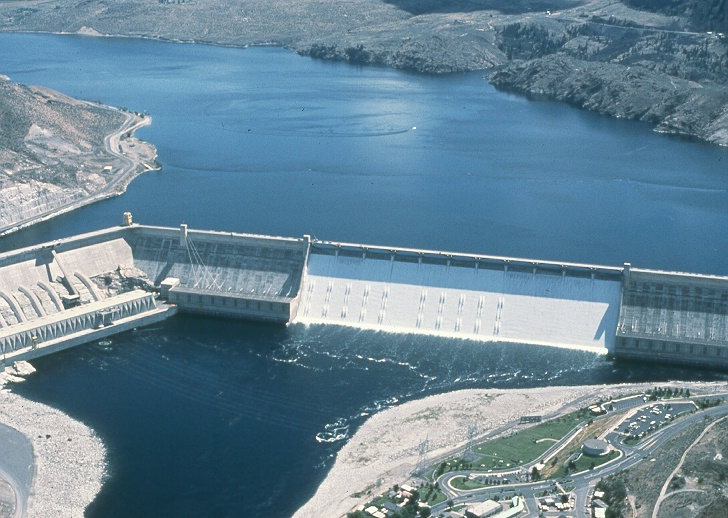
Photo: U.S. Bureau of Reclamation
More:
- Video on Grand Coulee's construction
- Smithsonian article on the 75th anniversary of the dam's completion