


Overview
Load forecasting provides a long-term outlook of the demand for electricity across the region. For the Ninth Power Plan, the forecast extends out through the year 2046. While the forecast is a fundamental and early input to the power planning process, it is also a specific requirement of the Northwest Power Act. The Act requires a forecast of at least 20 years, and the forecast is used to help evaluate what resources best meet regional needs, with an emphasis on conservation as a resource.
The Council’s approach to load forecasting blends multiple analytical methods and disciplines. Each forecast begins with an in-depth look at past energy consumption in the Pacific Northwest. We can’t just look backward at past trends, however, as there may be changes ahead on the horizon. Planning for the Northwest electricity system went astray in the 1980’s due to inaccurate demand forecasts from the previous decade that relied too heavily on projecting past growth trends into the future.
To analyze future energy needs in the Northwest, Power Division analysts use bottom-up modeling that looks at end-use electricity consumption at the equipment level, and then builds up to the jurisdictional, state, and regional levels. Here’s a visual to explain the concept:
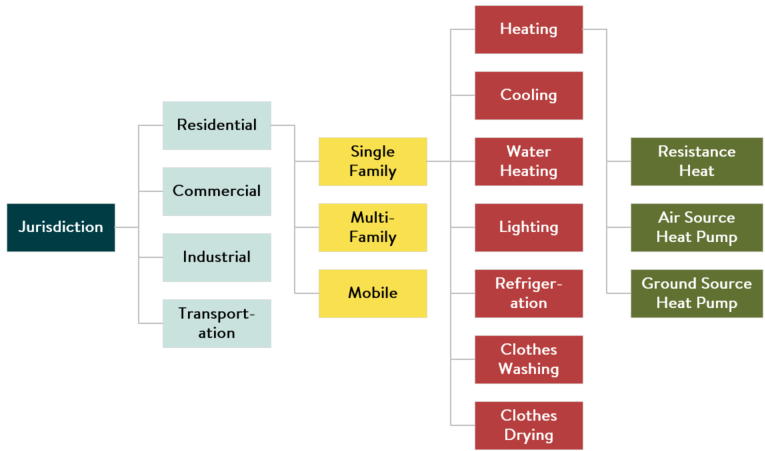
The Council’s load forecast also uses a top-down approach based on econometrics, which specifies statistical relationships that hold between various economic quantities, weather, and electricity demand in the Northwest. The Ninth Plan’s load forecast takes a hybrid approach – combining end-use modeling and econometrics
Creating and publishing a load forecast spanning Idaho, Western Montana, Oregon and Washington across a 20-year time period is an ambitious undertaking. However, through the careful development of an end-use adjusted modeling framework and a meticulously crafted set of inputs which capture potential future weather and economic trajectories, we hope to capture the range of possible futures. We would welcome you checking back in 20 years and seeing how we did. In the meantime, here’s some more explanation of our process and the results for the period 2027-2046 for the Northwest’s electricity grid.
Where we have been
The load forecast covers each of the 13 balancing authorities or zones within Idaho, Western Montana, Oregon and Washington. Each zone is unique in terms of geographic size, weather, urban and rural mix, and industry. For a historic perspective, from the years of 2010 through 2020, annual electricity demand in the region remained relatively level, staying within a range between roughly 20,500 average MW (aMW) to 21,200 aMW. Demand began to pick up in 2021 and has steadily grown since, reaching 22,335 aMW by 2025. Along with overall demand growth, summer hourly peaks really grew, starting with the record heat dome event in the summer of 2021. With hotter summers and more homes and businesses installing air conditioning units in response to the heat, the summer peak trend is expected to continue. The graphic shows the historic average annual hourly load (aMW) and the region’s seasonal peak (maximum single hourly load MW).
Though electricity demand was relatively flat from 2010 through 2020, population was growing. This results in a declining number for electricity demand per capita. This value hit its minimum in 2020 with COVID, but since 2021 it has rebounded. This is due somewhat to the nature of the recent load growth placed on the system from data centers, which is not population dependent.
Where we are going
For the Ninth Plan’s forecast, we used three different climate model weather projections with five unique economic and end-use projections to create fifteen unique futures. Here’s another visual of the five pathways to help explain:
| Pathway | What we are testing | Economics | Transportation | Data center | Building electrification | Industrial electrification |
| P1 | Persistent high growth | Medium | Higher | Higher | Higher | Higher |
| P2 | Persistent low growth | Lower | Lower | Lower | Lower | Lower |
| P3 | Early growth | Medium | Lower | Higher | Lower | Lower |
| P4 | Late growth | Medium | Higher | Medium | Higher | Higher |
| P5 | Mixed bag | Medium | Higher | Medium | Lower | Lower |
Each long-term forecast generates hourly load for each of the thirteen individual load zones and the combined overall regional outlook. The modeling of the region is complex, involving many factors. However, there are key forecast drivers which help to determine the future trajectory of load:
- How will the housing and commercial building stock change over time in terms of numbers, square footage, and weather sensitive electricity end-use
- How many air conditioners are installed?
- How many customers are turning to electric heat pumps for space and water heating
- How does economic growth influence industrial demand for electricity
- How many electric vehicles are on the road and how and where are they being charged?
- How many data centers are built-out and when and where?
- How many households and businesses install rooftop solar systems?
The next graph summarizes the forecast – the range of the fifteen future energy (aMW) trajectories and peak hourly load (MW). Note that is what is known as the frozen-efficiency load forecast. This forecast provides the demand input to the power planning resource and adequacy models. This means that the future forecast does not reflect the benefit of new incremental energy efficiency or demand-response programs. There is a second phase of the power plan forecast where the power plan’s recommended levels of conservation and demand-response are included, which will ultimately result in lower overall demand for annual energy and peak.
Since we forecast down to the hourly level by sector, we can study exactly what is driving growth in energy and peaks. The next two graphics show the annual energy and peak contribution from each sector for a specific future climate weather pattern and economic future.
These graphs are specific to the late growth pathway (P4 in the above table). This future has high building electrification, meaning more homes and businesses converting to electric heat pumps for space and water heating, and more electric cooking appliances. In this future, the data center load is expected to grow at a more moderate rate.
By looking at the system peak contribution, we can see the sectors that are weather sensitive (residential, commercial, building electrification), and time of day sensitive (electric vehicle charging).
For more information and data, here are links to a short video explaining how we’re helping to prepare the Northwest power system for future extreme weather events, and to the demand forecast results and other demand presentations. All our data is open and downloadable for the public. Have a question? Reach out to Senior Energy Forecasting Analyst Steve Simmons.
Preparing the power system for extreme weather