



Expert panel addresses data center energy efficiency, load flexibility, and water impacts in Pacific Northwest
Panelists include Columbia River Inter-Tribal Fish Commission, building design specialists PAE Engineers, Electric Power Research Institute, and Portland General Electric
- January 27, 2026
- Peter Jensen
A building design standard for data centers in the Pacific Northwest could reduce peak energy consumption in their electrical and mechanical systems by one-fifth, the Council heard during a panel discussion at its January meeting in Portland. However, the design standard comes with an associated impact of water usage. Additionally, panelists discussed programs allowing data center companies whose projects agree to load-flexibility requirements and other standards to speed through grid planning processes and get interconnected sooner, similar to how TSA PreCheck will get you through airport security lines quicker.
Later this year, the Council will be adopting a new 20-year power plan for the Northwest’s electricity grid, called the Ninth Plan. A key piece of this plan is the cost-effective resource strategy and recommendations that ensures the region will continue to experience an adequate, efficient, economical, and reliable power supply over the next two decades. The energy needs of data centers will play a prominent role in the Ninth Plan, so the panel discussion provided an opportunity to learn from research and on-the-ground demonstration projects happening at the regional and national level.
The Council heard from Christine Golightly, Policy Analyst with the Columbia River Inter-Tribal Fish Commission, as well as Karina Hershberg and Ben Burnett, PAE Engineers. PAE recently conducted a study analyzing the energy and water use impacts of build system design for data centers, which provided insights to inform potential energy efficiency standards and other possible strategies to address impacts from water consumption.
The panel discussion also featured Baskar Vairamohan, Technical Executive with the Electric Power Research Institute, and Isaac Barrow, Senior Manager for Data Centers with Portland General Electric. They spoke to data centers’ capacity to be flexible with their energy consumption, and strategies for addressing large-load interconnection issues. (Read presentation | watch video)
The Council’s role in addressing data centers’ energy use
The future energy needs of data centers in the Northwest carries substantial uncertainty surrounding its ultimate pace and scale. Under the NW Power Act of 1980, the Council represents Oregon, Idaho, Washington, and Montana in producing a 20-year power plan for the Northwest’s electricity grid. Primary components of each plan are a load forecast and a cost-effective resource strategy of supply- and demand-side resources that will meet the region’s need for electricity over the next two decades. The Council is working to release a draft of the Ninth Plan to the public by early summer 2026, and adopt the final version by November.
Energy efficiency called for in the Council’s past power plans have helped make the Northwest a national leader. Energy efficiency has played a vital role in keeping regional power costs among the lowest in the U.S. over the past two decades, and protecting the Northwest grid’s resource adequacy. The region’s per-capita energy use is well below the national average and its economy produces more using less energy, compared with the U.S. overall.
In an April 2025 load forecast, Council power planners stated that they expect the bulk of the near-term future energy demand to come from data centers and chip fabs in the Northwest. By 2030, they forecasted approximately 1,500 aMW of new growth on the low-end, 2,500 aMW for the medium trajectory, and 5,000 aMW on the high-end.
The Council will be addressing data centers’ future energy use in the Ninth Plan’s broader regional strategy. This will include providing recommendations on cost-effective resources to meet this load growth, including any potential actions to ensure energy efficiency and leverage demand flexibility. In addition, the Council can and does provide broader recommendations on crucial issues in support of the resource strategy. For example, in the 2021 Power Plan, such recommendations focused on generating resources’ siting considerations, resource sharing, and transmission constraints.
Key issues, potential solutions on efficiency
CRITFC hired PAE, a building engineering consulting firm, to analyze potential building designs for data centers. The research is in support of CRITFC’s 2022 Energy Vision, which identified energy efficiency and reducing peak energy demands as top priorities.
Hershberg and Burnett discussed their results. Burnett noted that in Washington and Oregon, many data center projects are subject to a building design set forth in an ASHRAE standard energy code. This covers annual energy consumption, but does not address peak demand periods.
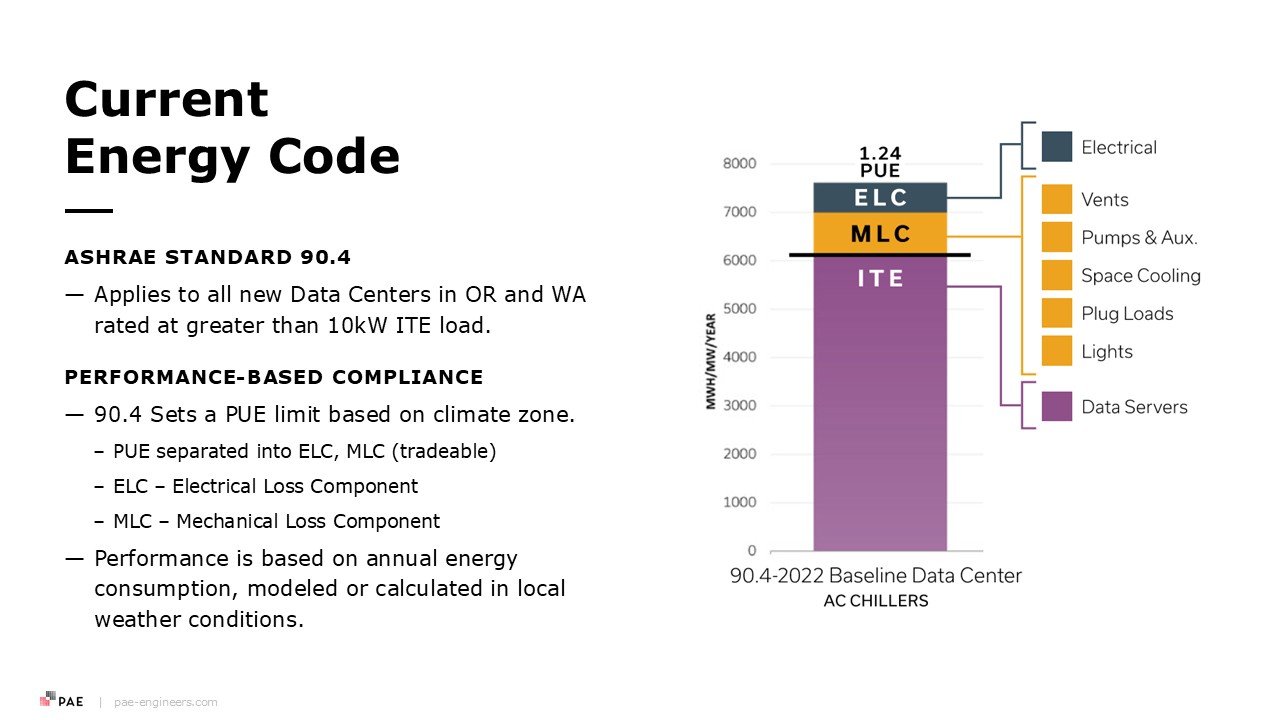
Burnett and Hershberg focused their discussion on how to improve efficiency for data centers’ electrical systems as well as mechanical systems such as vents, pumps, space cooling, plug loads, and lights. They did not address data servers.
Since data centers produce substantial heat in their operations, cooling is necessary. Some facilities use water in this process, including through a practice called evaporative cooling, and using other techniques. Burnett said this is not a major consumer of water, although the amounts of water are reduced due to evaporation, so less is returned to the source.
The benefit includes an annual energy consumption reduction of 6%, and a peak energy demand reduction of 20% for electrical and mechanical systems in data centers. This is compared with processes that use air cooling in data centers. However, risks include water availability, and it requires complex, pricy treatment systems.
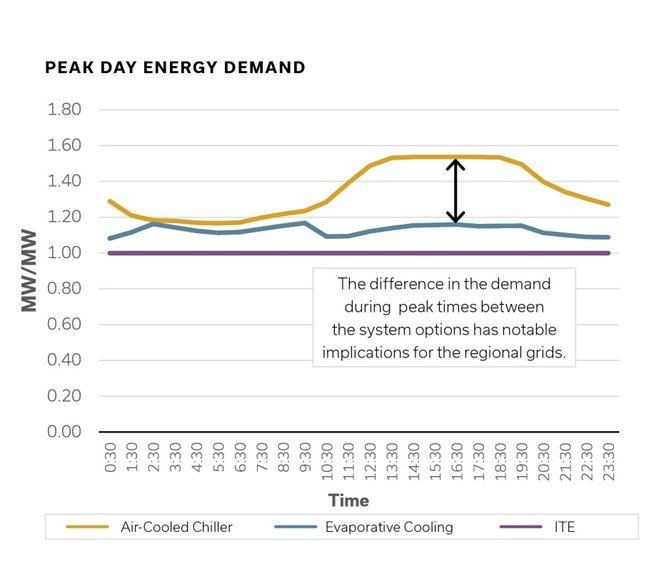
“At the end of the day, data centers with very similar annual energy use can have vastly different peak energy use,” Burnett said. “The current codes do not address this at all, nor do any of the other regulations around building (data centers). Part of the trade off is that when you’re looking at the evaporative cooling, now you’re talking about using water and using water directly.
“It had a very significant reduction of peak energy demand, even before we get to talking about grid flexibility. This potentially allows data centers to run flat-out during times of peak demand, and not really peak with the rest of the system. Of course, there’s no free lunch. There are risks associated with this – water availability, water quality, and then treatment systems that can be complex and expensive.”
Load flexibility for data centers
Vairamohan and Barrow spoke next. Vairamohan addressed EPRI’s DCFlex program, which is a research and development initiative that launched in 2024 with participation from tech companies, utilities, and grid operators in the U.S. as well as internationally. An initial group of pilot programs was established in Arizona, North Carolina, and Paris, France, and has since expanded to Virginia, Illinois, and Oklahoma.
At an Arizona location last summer, a data center successfully shrunk its power usage by one-quarter during peak demand hours on the grid. It accomplished this while maintaining artificial intelligence compute quality. The test was part of the first phase in DCFlex’s hubs.
Vairamohan said if these kinds of load-flexibility tests continue to prove successful in real-world tests, it could create opportunities where a data center developer could move through grid-planning processes faster, provided they agree to load-flexibility standards or other agreements. He drew a comparison with how airline travelers can get through security lines faster by enrolling in the TSA PreCheck program.
Barrow spoke to how PGE is using flexibility as part of its large-load interconnection process for data centers in Hillsboro. Last fall, PGE announced that it was partnering with a startup company called GridCARE. GridCARE looks for spare capacity in the power system by using artificial intelligence, in-depth demand modeling, and flexible resources such as batteries and onsite generators. The flexibility it could identified allowed PGE to interconnect several data center customers “years earlier than initially expected,” they said in a news release.
Barrow also addressed other ways the utility is using technologies to achieve large load flexibility. That includes existing options such as backup generators, battery storage, and dispatchable-standby generators. There are also emerging technologies that PGE is exploring, including demand response through GPU throttling, DR through geographic shifting, linear generators, and long-duration battery storage with 100 hours of capability.