

Power Division’s resource optimization modeling results show consistent themes across sensitivities
Council aims to have draft of Ninth Power Plan ready for public review and comment by July
- April 29, 2026
- Peter Jensen
A primary objective for the Council’s regional power system planning is to craft a cost-effective resource strategy that is robust across future uncertainties, while assuring the Northwest of an adequate, efficient, economical, and reliable power supply.
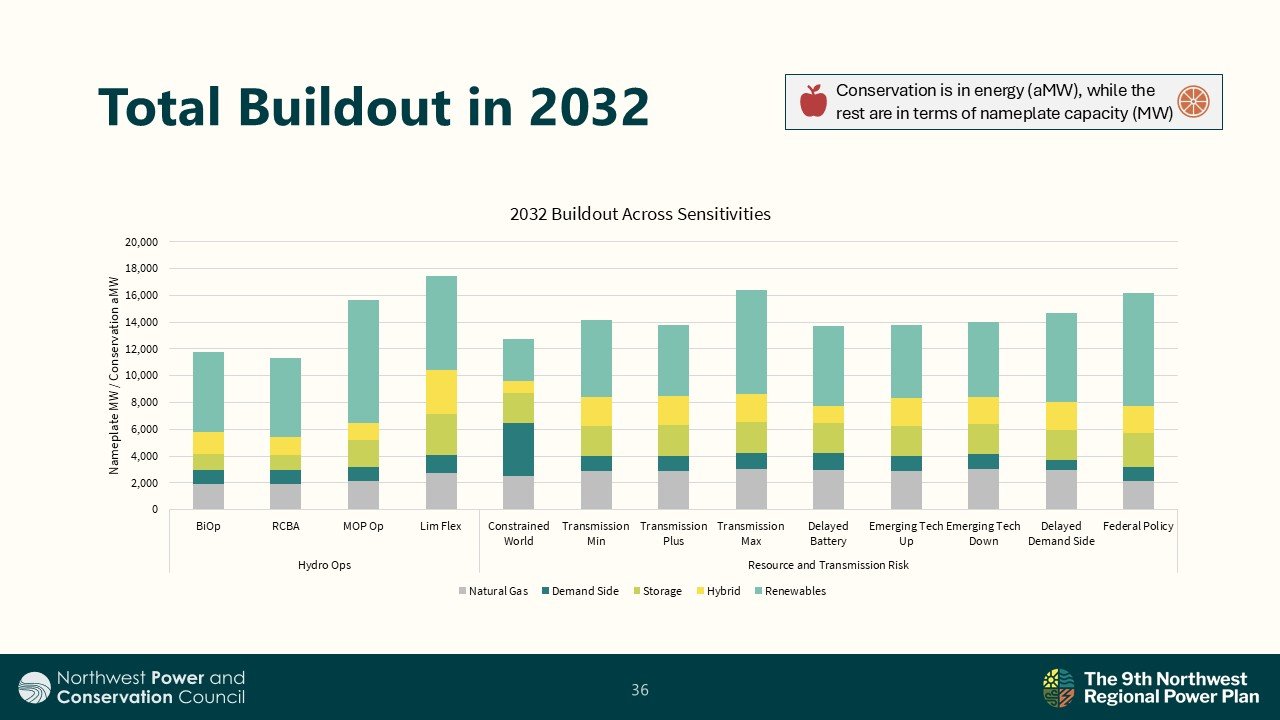
As the Council continues to make progress toward developing the resource strategy for the Ninth Power Plan this year, Power Division staff has reached a significant milestone. They have completed regional resource optimization modeling. They presented results of this study at the Council’s April meeting in Whitefish, MT (read presentation | watch video). This modeling tests different potential buildouts of the Northwest power system over the next 20 years.
Exploring 13 sensitivities
Council staff used the resource optimization modeling to test 13 sensitivities exploring a range of uncertainty and risk. Four of these sensitivities relate to potential changes in the operations of the Columbia Basin hydrosystem, while the remaining nine analyze differences in new resource and transmission assumptions. The buildout of each sensitivity seeks to meet the power system’s future needs as identified in the Ninth Plan’s needs assessment. Staff used the Council’s multi-metric resource adequacy standards to test each of the 13 results and thus ensure it would be an adequate power supply. All 13 passed the adequacy tests.
It's important for the public to understand how these modeling results will be used. Primary components of each power plan are creating a load forecast of future energy needs for the Pacific Northwest power grid, and then a cost-effective strategy of the supply- and demand-side resources that should be added to the system to meet these energy needs.
The results of the resource optimization study will help inform and guide the Council’s decision-making in developing the Ninth Plan’s cost-effective resource strategy and supporting recommendations. The Council will consider the modeling results along with other analysis that staff has produced in the power planning process over the past two years.
The framework for the Council’s resource optimization modeling provides important context for understanding the results. For each sensitivity, the model optimizes new resource development to meet needs across a range of potential futures that account for different load growth, hydro and renewable conditions, and gas prices. The Council ran 13 unique studies, each of which further tested uncertainty around either existing system capabilities (such as the hydro operations) or new resource availability and costs. The collection of these results yields information that helps develop a resource strategy that’s robust across this wide swath of future uncertainties. For more information about the sensitivities and other details of the scope of the resource optimization modeling, staff provided a primer at February’s Council meeting.
Crafting the Ninth Plan’s resource strategy will require analyzing the full breadth of results across all the 13 sensitivities. The Council discussed follow-up questions and explored results and subsequent analysis in more depth at its webinar meeting held April 28-29 (read presentation | watch video). The subsequent analysis presented at the webinar focused on costs, emissions, resource utilization, and the variability across the range of futures tested. In recent weeks, staff have also discussed these modeling results with advisory committees consisting of power system planners, utilities, technical experts, and other regional partners.
The Council plans to spend its upcoming meetings in May and June to discussing and developing the Ninth Plan’s resource strategy and recommendations, with the objective of adopting a draft plan in July. Adopting the draft plan would commence a public comment and hearing process later in the summer and fall. The goal is to adopt the final Ninth Plan in November 2026.
Key themes emerge across sensitivities
In reviewing analysis of the 13 sensitivity results with the Council, staff explained some of the consistent themes and key takeaways that emerged. The first is that the need for a portfolio of resources is seen throughout the Ninth Plan’s planning horizon of 2027-2046. Its action plan period will be 2027-2032. Under the Northwest Power Act, the Council reviews and updates its power plans on roughly five-year cycles. So, the Council will be developing its next power plan toward the end of this action plan period, in 2030-32.
From 2027-2032, staff’s analysis found:
- Energy conservation, demand response, wind, solar, battery storage and natural gas show up in every sensitivity in all years available.
- Long duration energy storage also shows up in all but two. This resource was not permitted in one sensitivity; in the second its costs increased 50% higher.
Over the full 20-year period:
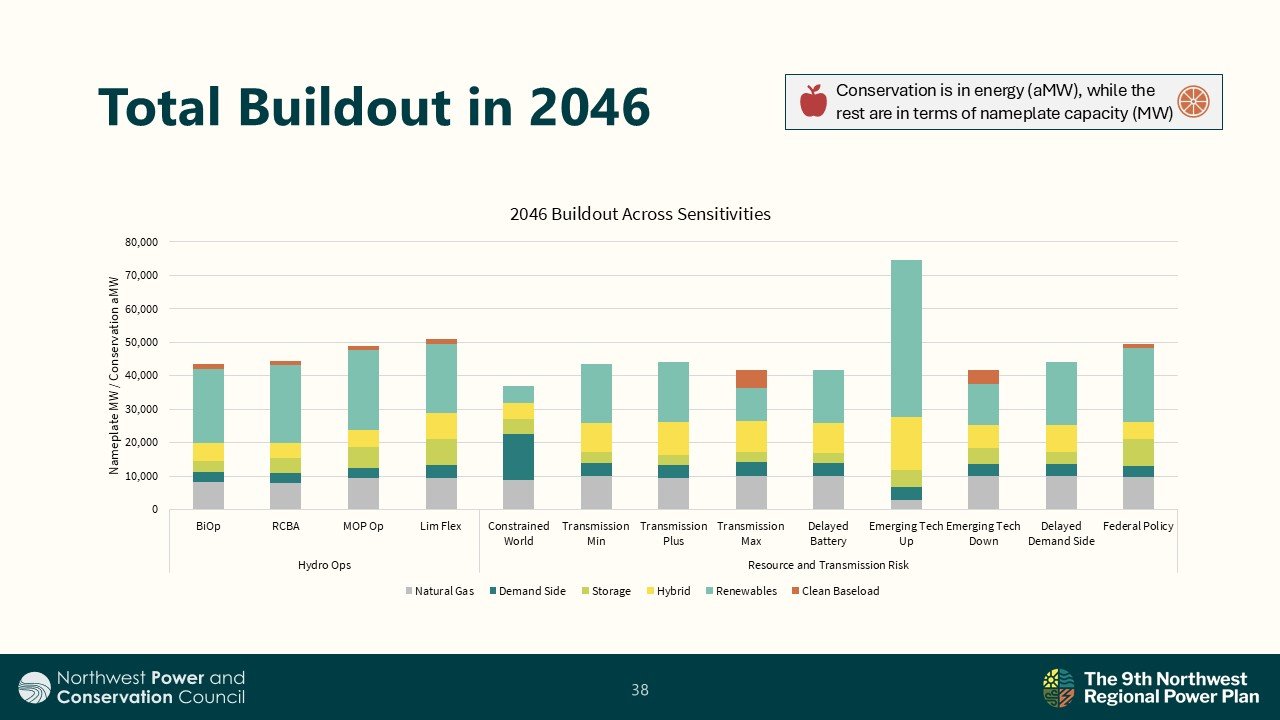
- Conservation, demand response, wind, solar, storage, and natural gas continue to play a role.
- Conventional geothermal and clean medium duration storage also show up in every sensitivity, in many cases as soon as they are available to the model.
- Clean baseload shows up in 2046 in roughly half the studies.
- Rooftop solar, pumped storage, and offshore wind only show up in one sensitivity each, meaning there is not a strong signal for these resources.
More themes spanning the breadth of the 13 sensitivities emerged from staff’s analysis. One is that a mix of resources is needed to meet a diverse set of needs including adequacy, policy, and economics.
Another key theme focused on hydro flexibility. The resource optimization model picked up differences in Columbia Basin hydro operations, particularly those seeking to minimize daily ramping of the system. This means that the hydrosystem can play an important role in overall power system flexibility, but when it’s necessary to limit that flexibility for the benefit of fish, new resources can be developed that provide those same attributes.
Finally, the Ninth Plan is the first of the Council’s power plans to model the region by zone. This allowed better reflection of differences in load growth, policy requirements, transmission access and connections, as well as resource availability and profiles. The computer modeling reflected this and showed different signals for certain resources within zones. This will allow the power plan to provide insight on the locational value of resources.