



Council addresses hydrosystem modeling issue, provides update to Ninth Power Plan’s upcoming process in 2026-27
Council received over 1,200 public comments on draft Ninth Plan from residents, industries & organizations across Oregon, Washington, Idaho & Montana
- November 24, 2026
- Peter Jensen

At the Council’s November meeting, Power Division staff provided an update on actions taken to address an issue with the modeling set-up used to analyze Columbia Basin hydrosystem operations in the draft Ninth Power Plan. They also reviewed summaries of public comments on the draft plan, as well as a proposed timeline for releasing the second draft.
Power Planning Director Jenn Light, Manager of Planning and Analysis John Ollis, and Power System Analysis Dor Hirsh Bar Gai led the presentation (read presentation | watch video). The Council identified the issue during the public comment period for the draft Ninth Plan earlier this fall.
Explaining the issue
Ollis and Hirsh Bar Gai walked through what happened with the GENESYS model. Ollis emphasized that this is an issue with how staff set up the model, not with the model itself.
Power Division staff have used GENESYS in their power planning since 1999. GENESYS helps staff analyze future operations of the Northwest power system and ensure the system has an adequate power supply to meet energy needs. It is also an analytical tool the Council uses to model hydrosystem operations in the Columbia Basin.
Prior to starting work on the Ninth Plan in February 2025, staff added an enhancement that sought to mimic real-time system operations, yielding insight on future water conditions and how they guide operational decisions that affect power generation. This split the modeling between weekly and hourly stages.
The amount of water should be the same for the same week across these two stages. In the initial runs, however, there were times when the model would create more (or less) water to meet model requirements for operations. More water equates to more flows, which can result in more power generation, resulting in the draft power plan assuming less of a need for new resources to meet future load growth. This will require adding thousands of megawatts of new generation above what the draft Ninth Plan called for.
Fixing the issue
Next, staff explained the actions they’ve taken to address the issue in GENESYS, some limitations that still exist in the model’s set-up, and why the Council feels confident in the model’s ability to guide development of a second draft of the Ninth Plan.
Staff improved the model setup to tighten the relationship between weekly and hourly, reducing the difference in the amount of water available between these stages. They also tweaked modeling of two reservoirs behind Mica and Keenleyside Dams, in the Canadian portion of the Columbia Basin. These updates significantly reduced the difference in water seen between the two stages. However, there are still periods where the alignment is not perfect. It is important to note not all those periods create an issue for the power system’s resource planning. Staff stated that the because the Council uses conservative methodologies for calculating planning reserve margins that guide the optimization modeling, it should provide sufficient buffer to cover the discrepancy in the updated model. Staff stated that they feel confident that they’ve addressed the issue, and can now move forward with developing the Ninth Plan.
Since confirming the existence of the issue with GENESYS in mid-October, the Power Division has held a series of meetings, including the Council’s Power Committee on Oct. 23, the Resource Adequacy and System Analysis Advisory Committees on Nov. 3 and Nov. 20, and the Council meeting on Nov. 17-18. Staff also hosted a question-and-answer public forum on Nov. 20. Each meeting has provided an opportunity to address the issue publicly, analyze and vet the proposed fix, and to discuss next steps for producing the second draft of the Ninth Plan.
New initial modeling results
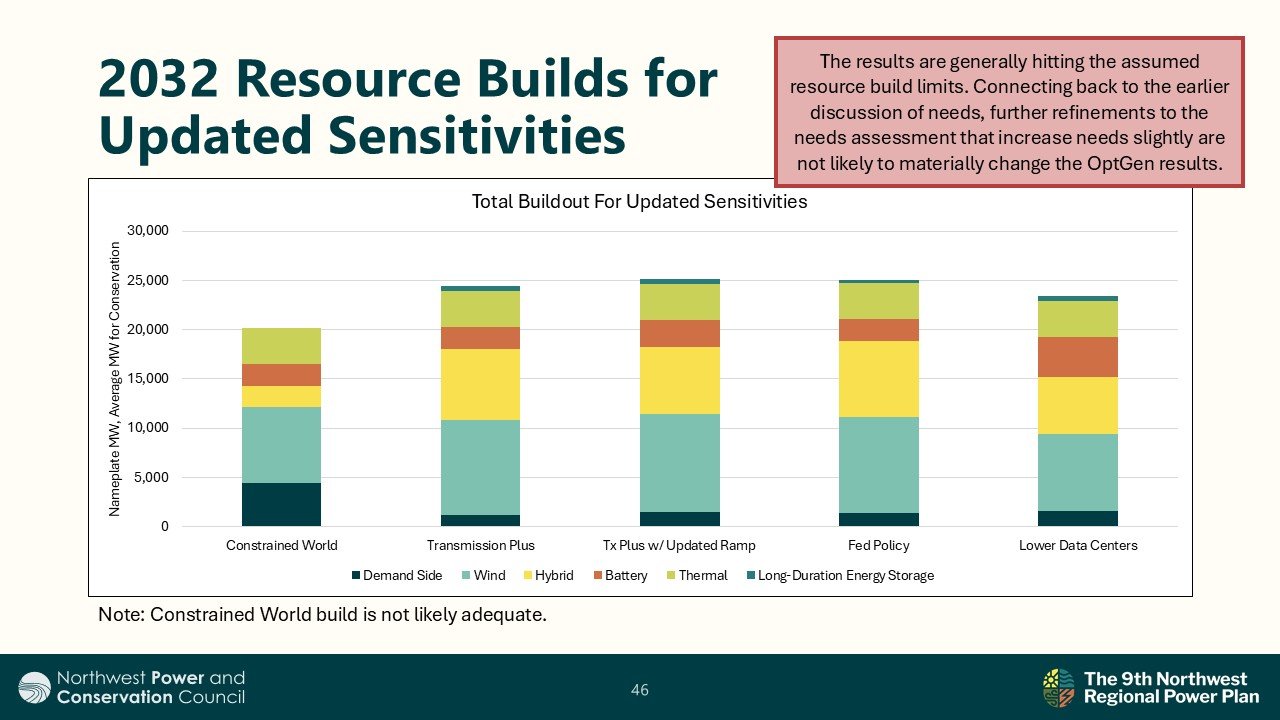
Light also discussed the initial results of the Council’s updated modeling, which would help inform development of the second draft of the Ninth Plan’s resource strategy. She briefed the Council on the key takeaways from the updated modeling runs:
- Demand side resources continue to support system needs when there are supply side resources limitations
- Natural gas continues to be selected up to the physical limits assumed in the modeling, with a continued focus on peaking plants
- Wind and hybrid solar + storage make up the bulk of the added resources to meet needs across sensitivities
- The modeling is hitting the assumed build limits in many cases, and the Plan’s resource strategy will need to consider hedging risks and supporting flexibility to adapt between plans as we learn more with our annual studies
Public comment on the draft plan and upcoming process for the second draft
The Council received over 1,200 public comments on the draft plan, and spent time reviewing them on Nov. 17-18. The Council thanks each person and organization for taking the time to provide comment and feedback on the draft plan, either through the Council’s website or at one of the eight public hearings held in Oregon, Idaho, Washington, Montana, and online in September and October.
Read all the comments here, as well as staff’s synopsis of them in this presentation and in these videos from the Nov. 17 and Nov. 18 meetings.
The Council will devote upcoming meetings to further analyzing these new modeling results, as well as discussing the feedback received through the public comment period. Light spelled out the proposed schedule for the Ninth Power Plan’s second draft:
- Dec. 15-16: Continued discussion on results, deeper analysis on the resource strategy, and staff recommended changes to the power plan in response to public comments
- Jan. 12-13: Continued discussion of the resource strategy and plan language
- Feb. 9-10: Potential release of the second draft
Depending on whether the Council uses a 45-day or 60-day public comment period for the second draft, it would put the end of the next comment period at the end of March or in mid-April.
The Council would take time to review the feedback and make decisions on how to shape the final draft of the power plan. That would place adoption of the final Ninth Power Plan between May-July of 2027.